Reckon: You Know More Than You Think
I made a daily estimation game for people who say “I have no idea” a little too quickly. Five questions. Two bounds. One best guess. How close is close enough?
A small thing that drives me crazy at work is when someone says they have no idea, when what they really mean is that they do not know the exact answer.
Someone will tell me a file is huge and it will never work. I ask how many rows it has. “No idea.” Fine: is it more than a million? “Oh, definitely not.”
Then you do have some idea.
That distinction matters. An exact answer can be unavailable while a useful range is sitting right there, waiting for someone to admit it. Reckon is a game built around that admission.
There is almost always a place to start.
The idea borrows from Fermi estimation: when a question looks impossible, break it into things you can reason about, choose some sensible bounds, and get moving. You may not know how many paper clips fit in a coffee mug. But you know a mug is not the size of a thimble or a bathtub. You know a paper clip is smaller than your finger. Suddenly “I have no idea” has become “probably more than 50 and less than 2,000.”
That is not a very good estimate. It is, however, an estimate. More importantly, it can be tightened.
I wanted to make that little act of reasoning feel rewarding: not recalling a fact you happened to memorize, but noticing how much you can infer from everything around it.
First, admit how uncertain you are.
Every day, Reckon gives you five numeric questions. For each one, you enter a low estimate, a high estimate, and then a single best guess. If the real answer falls inside your range, you can earn up to 300 range points. A narrower range is worth more. Your best guess adds an accuracy bonus of up to 500 points, with all 500 reserved for a bullseye.
The range is the interesting part. Make it very wide and you are likely to catch the answer, but you have not demonstrated much confidence. Make it too narrow and you may get nothing. It is a tiny negotiation between caution and ego, repeated five times.
Your best guess does not have to sit in the middle, either. If you think there are between 2,000 and 20,000 grains of rice in a cereal bowl, but suspect the answer clusters toward the lower end, you can say so. There is a “choose middle” button when the midpoint really is your best answer (or when arithmetic feels like an unreasonable extra challenge).
Three numbers are more revealing than one.
The mobile game keeps the whole decision together: lowest, highest, best.
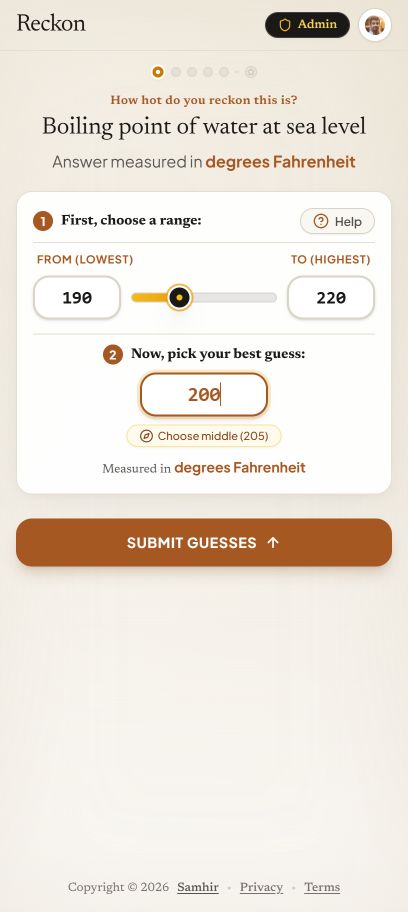
Five tiny negotiations with yourself.
The answer appears as soon as you submit, along with the damage—or the vindication. Then it is on to the next question. A row of dots keeps the five-round game legible, and unit controls let you answer in the system that makes sense in your head rather than the one chosen by the question.
The immediate reveal matters. Waiting until the end would turn the game into a quiz. Seeing the answer round by round makes it feel more like a conversation with your own intuition: too broad, too bold, suspiciously close, try again.
Five questions also felt like the right length for a daily game. Long enough for one bad estimate not to ruin everything. Short enough to finish on a phone while waiting for coffee.
The score is the headline. The calibration is the useful part.
After five rounds, Reckon shows the result first, then lets you inspect where the points came from.
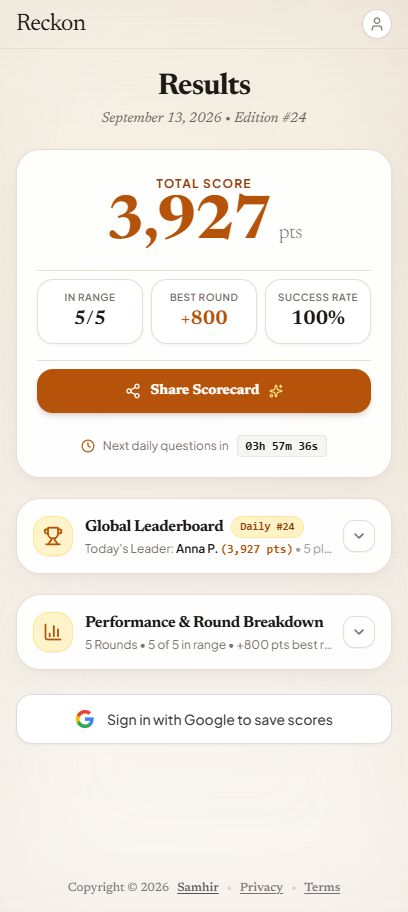
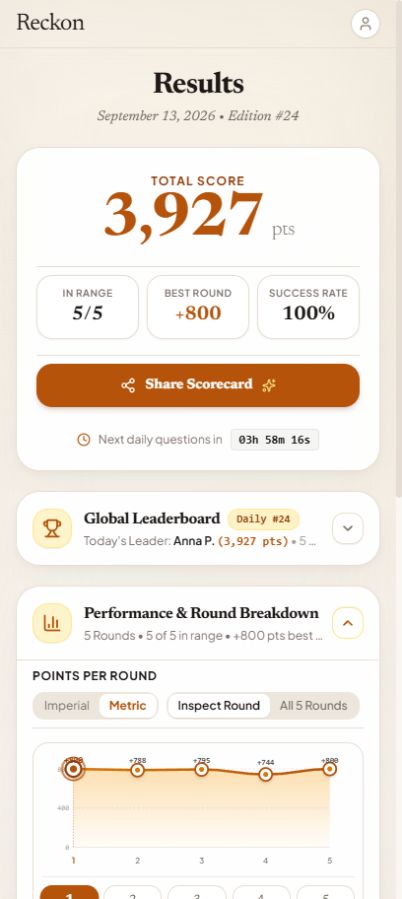
Confidence becomes a social sport.
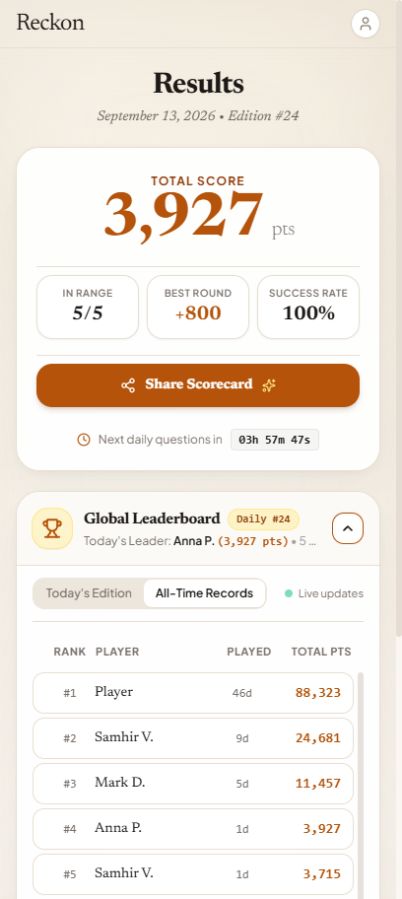
When you finish, your score lands on a live daily leaderboard. Names are kept to a first name and last initial, and a shareable scorecard lets you brag without forwarding anyone a spreadsheet. You can also switch to all-time records, where the game tracks days played and total points.
Anyone can play as a guest. In my mobile test, “Anna P.” appeared on the daily table immediately. Signing in is about continuity: it saves scores, streaks, history, and statistics over time; lets you pick up on another device; and gives you a persistent identity with a chance to climb the all-time leaderboard.
Anna P. scored 3,927 points, put all five answers in range, and briefly led the day. This is excellent evidence that the scoring system works. It is weaker evidence that Anna P. is some kind of estimation savant.
Today is fun. Over time is revealing.
The all-time view makes regular play—and not just one lucky round—visible.
The questions are the product.
The interface is simple by design. That means the prompts have to do a lot of work. A good Reckon question needs a real numeric answer and a credible source. It should be surprising without being arbitrary, and unfamiliar without becoming impossible to reason about. Five questions in a day should also feel varied—not five different ways to ask how long something is.
To help with that, I wrote a Claude skill that drafts candidate questions in a consistent format. The skill is useful for range and volume; it is not the editor. I still review the wording, check the answer and source, tune the unit, and decide whether a prompt actually feels estimable.
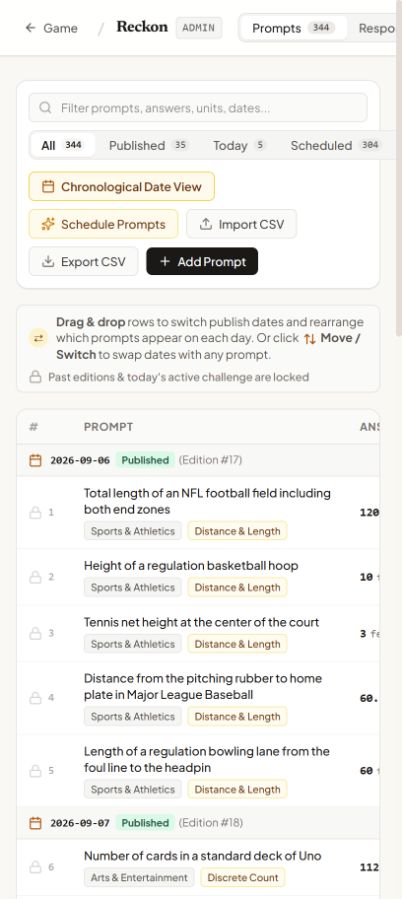
I built a separate admin interface for the rest of that work. It lets me add and edit prompts, classify them by topic and type of measurement, import or export them in bulk, and schedule five at a time. I can drag questions between dates, rearrange their order, or swap one out without rebuilding the game. When I took this screenshot, the library had 344 prompts: 35 published, five live that day, and 304 scheduled.
There is also a response view for inspecting how people actually answered and exporting the data. That is where the game can get more interesting over time: not just which questions were hard, but whether players are learning to set better ranges.
A game needs an editorial calendar.
The prompt library turns AI-generated candidates into sourced, scheduled daily sets.
The admin is usable on a phone, but it is unapologetically dense. This is one screen where desktop still wins.
Vibecoded in about three hours.
I built the first working version of Reckon in about three hours with Google AI Studio, for free.
That sentence still feels faintly absurd. In an afternoon, I went from a scoring idea to a real mobile game with daily questions, live results, leaderboards, Google sign-in, stored player history, and an admin system. AI Studio wrote a great deal of the code while I described the experience, tested it, found the weird edges, and kept asking for changes.
Three hours is not the same as effortless, though. The code arrived quickly. The choices did not make themselves. How wide should a safe range be? Should a precise best guess outweigh a sensible interval? What happens when players switch units? Which statistics deserve to follow someone across devices? And, most importantly, are the questions any good?
The rough edges are real, too. The first-time explanation adds a little friction before play. The admin is cramped on mobile. And the entire game depends on a steady supply of prompts that are correct, sourced, varied, and fun. AI made it much faster to build the machine. It did not remove the need to tend it.
So, are people better at estimating than they think?
Reckon is not a scientific experiment, at least not yet. But it does make one useful idea hard to avoid: uncertainty is not the same as ignorance. Even a clumsy range contains information. Put a number on it, see what happened, and you may be surprised by how much you knew.
The next time someone tells me a file is huge, I will still ask how many rows it has. Now I just have a game to make the argument unnecessarily competitive.
Under the hood
Built with Google AI Studio in about three hours. Google sign-in and Firebase handle player identity and persistent data. A custom Claude skill drafts question candidates; the Reckon admin turns them into sourced, scheduled sets.
All screenshots on this page were captured from a live mobile playthrough on September 13, 2026.