A Better World Cup Bracket
I built the World Cup pool I wanted to play: more winners, a second chance, and enough live data to make bad predictions interesting. Made in Google AI Studio for $0 (and with roughly $0 worth of coding experience).
Because every mainstream bracket felt like a cesspool of ads and Web 1.0 design, I built my own platform without any software development experience. It became an imperfect, fully functioning experiment in vibecoding—and in how much data 62 football fans can generate while being mostly wrong.
Are mainstream bracket websites broken?
Honestly, not really. They accept picks, calculate points, and crown a winner. A bridge would be considered successful for much less.
But I generally find bracket sites clunky, crowded with ads and article links, and oddly uninterested in the actual people playing. I also don't love trading my data for the privilege of guessing that Belgium will finally put it all together. Then come the promotional emails long after the tournament ends. No thanks.
I had one bigger complaint: not nearly enough winners. Many pools save nearly everything for the final standings, which means one rough group stage can turn the next month into a long exercise in watching somebody else win.
So I started with a short list of things I wanted instead:
- Scoring that could reward group-stage accuracy, knockout picks, bonuses, and the champion differently.
- More payout slots, including prizes before the tournament was nearly over.
- A second-chance bracket for anyone whose beautiful theory collapsed in week one.
- Live rankings, comparisons, and genuinely nosy analytics about everybody's picks.
- A private, ad-free platform that didn't sell user data or turn the mailing list into a hostage situation.
None of this is profound product innovation. It is, however, exactly what I wanted.
A bracket that kept starting over
The main pool asked each player for 88 predictions: every group finish, the third-place teams that would advance, the full knockout path, and a champion. I could change the points and bonuses from an admin panel, then lock picks when the tournament began.
The $2,480 prize pool was also split across two moments. A quarter went to the best group-stage brackets; the rest went to the final leaders. Three players correctly predicted seven complete groups, and a 96th-minute Austria equalizer helped decide the podium. It was the sort of late, meaningless-to-most-people goal that suddenly meant $310 to one person in my inbox.
Most of us managed four perfect groups. The leaders got seven.
The group-stage view broke down perfect picks, score distributions, and which groups the crowd found easiest or most chaotic.
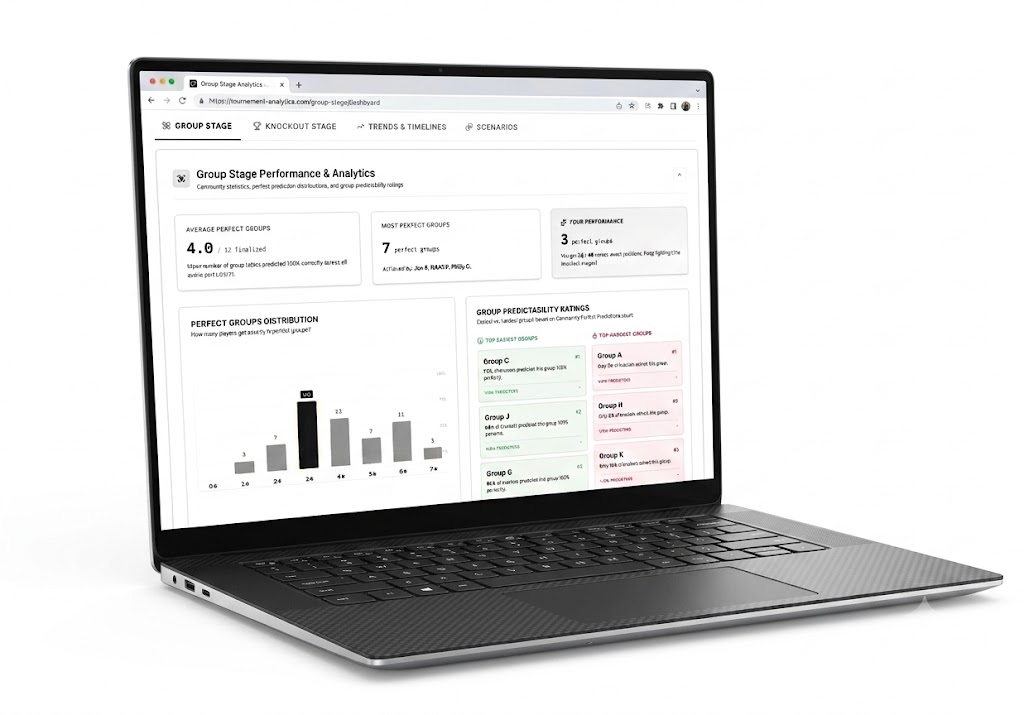
Then, for 15 hours on the day the knockouts began, a separate $20 second-chance bracket opened with the actual 32 qualifying teams. It had its own leaderboard and payouts. The main bracket rewarded foresight; the second one rewarded the ability to look at weeks of evidence and form a new, equally doomed opinion.
Payment status lived in each player's profile, and I could verify entries before admitting them to the pool. Google-managed sign-in and cloud services handled the accounts and saved picks. I still had to answer the occasional “did mine save?” email from someone using a phone, because experimental software remains experimental software.
The data became the game
Once the tournament started, I realized the predictions were more interesting together than apart. The 62 verified brackets produced 5,456 picks. Across the competition there were 183 lead changes, the average player scored 94 of 220 available points, and our collective pick accuracy was 43%.
62
paid brackets
5,456
total picks
183
lead swaps
43%
pick accuracy
The Insights page showed the crowd's champion consensus, the most predictable groups, and how many perfect groups each player managed. It could find the people with picks most similar to mine, then rank the “mavericks” who strayed furthest from the crowd. Before matches ended, a scenario simulator let me toggle future winners and watch the table recalculate—the digital equivalent of saying “I'm still alive if these eleven increasingly specific things happen.”
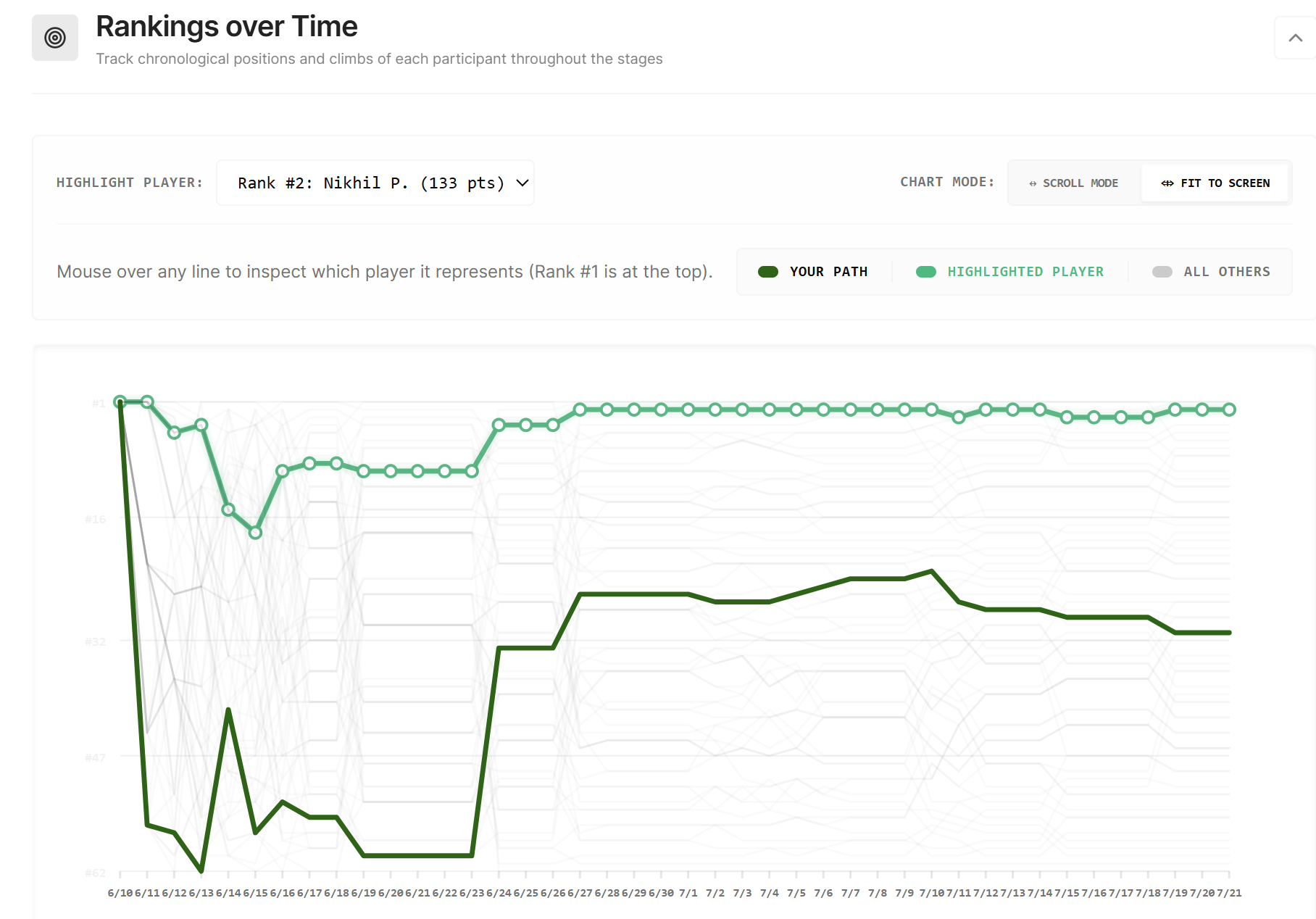
My favorite feature tracked every player's position over time. My own line began at #1 (a ceremonial honor shared by everybody before a ball was kicked), plunged to #62, and eventually clawed back to #31. A perfect visual summary of confidence meeting information.
The rankings moved 183 times. Mine mostly moved in the wrong direction.
Players could compare any two paths across 96 recorded ranking snapshots. Here, eventual runner-up Nikhil barely leaves the top while I discover the bottom of the chart.
The tournament recap tied it all together after the final: score distributions, champion gambits, group-stage standouts, knockout specialists, and both pools' winners. Spain won the World Cup after being picked by 16 players. Anna D. won our main pool with 134 points, completing a last-minute comeback to beat two players by a single point.
That one point is why the data mattered. A normal bracket would have shown a final table. This one could show when the table changed, which picks caused it, how unusual those picks were, and how narrowly everybody else missed.
Coding a full-stack app with no experience
About four months before kickoff, I opened Google AI Studio and started describing the bracket in plain language. I had never shipped a production-ready web application, built an authentication flow, or managed a live scoring database. This felt like an inconvenient amount of missing experience.
AI Studio turned those instructions into a working application. I asked for everything from account creation and database-backed picks to admin controls, score calculations, charts, and the scenario simulator. When something broke, I described the error, tested the fix, and usually discovered a more creative way for it to break.
The difficult part was rarely drawing a button. It was explaining the rules precisely enough: how third-place qualification should work, what happens when players tie, when each bracket locks, how scoring should update, and which details an administrator needs to see. AI could generate the code, but it couldn't decide what a fair pool felt like. That was the actual product work.
Google AI Studio cost me nothing to use. The low price matters—not because free software is automatically good, but because it made the cost of trying almost absurdly small. I could move from “someone should build this” to a real, password-protected pool without first becoming a developer or finding one willing to spend four months on my oddly specific scoring preferences.
That said, free did not mean effortless. I clicked through pick combinations, watched live scores, fixed mobile problems, checked players' saved data, and pushed updates throughout the tournament. The platform was shoddily vibecoded by a fan, as I warned everyone. It was also real enough to manage 62 people and several thousand predictions without ESPN, ads, or a marketing email about fantasy baseball.
So, was it better?
In some ways, definitely. More people won money. A bad first stage wasn't fatal. The pool stayed interesting between matches, and the same predictions that powered the scores also revealed how the group thought. The whole thing was private, ad-free, and open source.
It was not flawless. Mobile needed attention, a few workflows confused people, and I was both the commissioner and the support desk. A mainstream platform would have handled some of that with considerably less improvisation.
But 62 people completed the main bracket, returned for the rankings, and watched a one-point finish; a smaller group even entered the second pool. The app did not make us better at predicting football—the 43% accuracy settles that argument. It made being wrong considerably more interesting.
Under the hood
The Better Bracket was designed, prompted, tested, and administered by me; built with Gemini in Google AI Studio; and supported by Google-managed authentication and cloud services. The live tournament is over, but the recap and Insights page remain available.